
overview of ees
Earth and Environmental Sciences (EES) is a diverse department that blends contributions from geologists, ecologist, and environmental scientists. Our goal is to stimulate enquiry and learning about the fundamental physical, chemical, geological, and biological processes that shape Earth's natural environment. We seek to promote understanding of Earth systems and their components by integrating geological and biological views of how these systems function and interact. The department's fundamental work lies in basic research and field-based experiential education, but as a core department in Lehigh's Environmental Initiative we actively cooperate with other students and scholars to examine the ramifications of human interaction with the environment.
EES was formed in 1991 through the merger of faculty from the Geological Sciences Department with environmental biology faculty from the Biology Department. Since then we have worked to develop innovative programs in environmental science while maintaining strengths in such areas as tectonics, ecology, and surficial geology, all under an earth-systems context. Along with Civil and Environmental Engineering, EES is one of two core departments in Lehigh's new Environmental Initiative.
Undergraduate Study
For undergraduates, the EES Department offers BA and BS degrees as well as a minor. The accessible BA degree in Earth and Environmental Sciences is ideal for students interested in the science of earth systems and ecology but having career goals in areas such as law, journalism, business, and government. The flexible BA degree in EES also makes it easy for students to pursue a double major or design a degree that matches their interests. For students interested in technical careers in research or industry, the department offers a BS degree in EES. Finally, EES offers a straight-forward minor program that can include a significant component of field-based learning.
For graduate students, the department offers M.S. and Ph.D. degrees in Earth and Environmental Sciences. M.S. programs typically require two years of full-time effort and a Ph.D. about four years.
Faculty research programs span numerous disciplines within the fields of ecology, environmental science, and geology. The department has particular depth of expertise in tectonics, ecology and paleoecology, geochemistry, geophysics, environmental change, and Earth surface processes. The intermediate size of the department (15 faculty, 3 support staff, 5 postdocs and research scientists) and its range of active research programs provide an intimate atmosphere in which students receive extensive experience with diverse analytical and theoretical approaches to the study of geological, ecological, and environmental processes. There are 25 students in the EES graduate program who have come to us from many states and several foreign countries.
In recent years, our graduates have been very successful in finding employment in environmental consulting firms and oil companies, as post-doctoral researchers, in governmental agencies, and as faculty at colleges and universities.
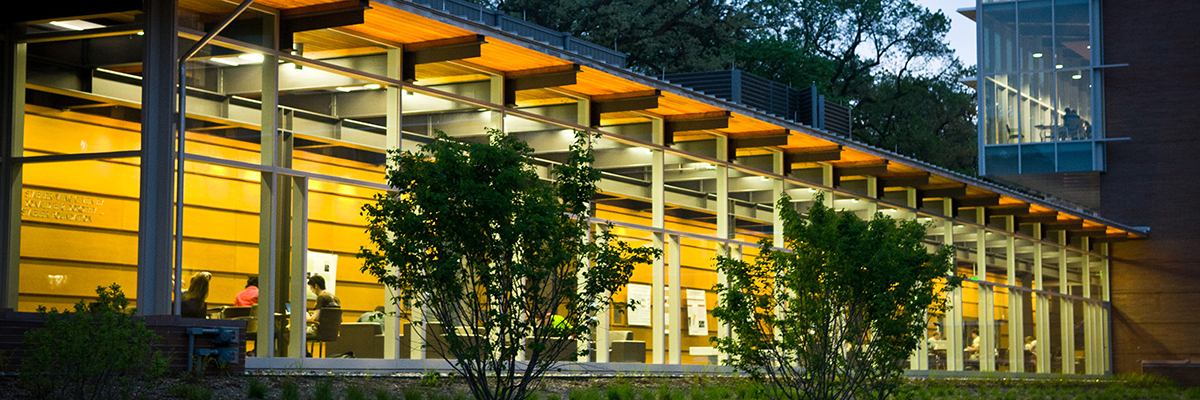
EES is currently housed in Williams Hall, a venerable building that has hosted much Lehigh history. In 2010, we will be moving into the new STEPS building along with other components of Lehigh's Environmental Initiative (STEPS - Science, Technology, Environment, Policy, and Society). This state-of-the-art green building will be an exciting new addition to intellectual life on campus, and we are busy working with the architectural firm of Bohlin, Cywinski and Jackson on the building's design, layout, and program.
Equipment for ecological research includes microscopes, environmental chambers, centrifuges, sampling nets, current meters, incubators, and autoclaves. The Department has a long history of multidisciplinary research in experimental and comparative studies of aquatic communities and ecosystems. Faculty operate facilities capable of a wide variety of analyses relevant to aqueous biogeochemistry, and also maintain automated meteorological and hydrological facilities as well as terrestrial and water-column instrumentation for measuring solar UV radiation.
To support research in paleoecology and paleoclimatology, we maintain sediment-coring and other sampling equipment, as well as labs for sample-preparation and analysis in areas such as tree-ring studies, palynology, and other high-resolution records in sediments and peat.
For research in the areas of geological science, EES houses a geochronology laboratory dedicated to Ar-Ar and U-Th/He analyses; a stable-isotope laboratory equipped to handle a range of geological and environmental materials; a geochemistry facility that includes an ICP/MS; lab facilities outfitted for biogeochemical analyses; and standard petrographic facilities, including cathodoluminescence and camera lucida digitizing apparatus. Geophysical equipment includes a complete paleomagnetism laboratory including cryogenic magnetometer and shielded room; a seismology laboratory equipped for data acquisition and processing at a range of scales, including multi-channel seismograph and ground-penetrating radar; and other field geophysical equipment including a gravimeter, proton precession magnetometer; and borehole logging equipment. Excellent sample characterization facilities are also available on campus in the Materials Sciences department (electron probe, TEM, SEM, and much more).
The Department's computing facilities include a variety of workstations, networked microcomputer laboratories, and numerous stand-alone PC's and Macintoshes. In conjunction with the Lehigh Earth Observatory, the departmental computers support GIS and remote sensing software. The university supports high-speed networking to offices, labs, and classrooms and provides access to high-performance workstations for computationally intensive tasks; in-house technical support for scientific computing is available in cooperation with the Environmental Initiative.
The EES Department is part of Lehigh University's College of Arts and Sciences. Lehigh is an independent, nondenominational, coeducational university. Founded in 1865, it has approximately 4,700 undergraduates within its three major colleges: Arts and Sciences, Engineering and Applied Science, and Business and Economics. There are approximately 2,100 students enrolled in various graduate programs and in the graduate-only College of Education. The 700-acre campus includes superb athletic facilities, a health club and cultural venues, including the Zoellner Arts Center.
Bethlehem, Pennsylvania (pop. 73,000) is located in the Lehigh Valley, 50 miles north of Philadelphia and 90 miles west of New York City; best access is via Interstate 78, U.S. Route 22, or Lehigh Valley International Airport (airport code ABE). Founded in 1741, Bethlehem has a rich cultural heritage in the Moravian tradition. Historical buildings have been well preserved giving the community a charming Colonial atmosphere. The Lehigh Valley (Allentown, Bethlehem and Easton, combined population of some 618,000) is the chief commercial and industrial center for east-central Pennsylvania.
Faculty and Their Expertise
- Frank J. Pazzaglia, Professor and Chair. Ph.D. Pennsylvania State University, 1993. Fluvial and tectonic geomorphology.
- Kenneth P. Kodama, Professor. Ph.D. Stanford 1977. Paleomagnetism, rock magnetism, environmental magnetism.
- David J. Anastasio, Professor and Graduate Coordinator. Ph.D. Johns Hopkins 1988. Structural geology, tectonics.
- Gray E. Bebout, Professor and Undergraduate Coordinator. Ph.D. UCLA 1989. Petrology, high-temperature geochemistry, stable-isotope geochemistry.
- Robert Booth, Assistant Professor. Ph.D. Wyoming, 2003 (arrives at Lehigh in January, 2006). Ecological response to climate change, paleoecology, paleoclimatology, ecology of testate amoebae.
- Bobb Carson, Professor Emeritus. Ph.D. Washington 1971. Sedimentary processes, sedimentation, tectonics, marine geology, submarine hydrology.
- Edward B. Evenson, Professor. Ph.D. Michigan 1972. Glacial and Quaternary geology, environmental geology and soils.
- Bruce Hargreaves, Associate Professor. Ph.D. UC Berkeley 1977. Physiological and ecosystem ecology, bioptics, limnology.
- Anne S. Meltzer, Professor and Dean, College of Arts and Sciences. Ph.D. Rice 1989. Seismology, high-resolution geophysics, tectonics.
- Donald P. Morris, Associate Professor. Ph.D. Colorado 1990. Microbial ecology, limnology.
- Carl Moses, Associate Professor and Deputy Provost for Academic Programs. Ph.D. Virginia 1988. Aqueous geochemistry, mineral-solution interface.
- Paul B. Myers Jr., Professor Emeritus. Ph.D. Lehigh 1960. Hydrogeology, geographic information systems.
- Stephen C. Peters, Assistant Professor. Ph.D. University of Michigan, 2001. Low-temperature (bio)geochemistry, hydrogeology, isotope geology.
- Joan Ramage, Assistant Professor. Ph.D. Cornell, 2001. Remote sensing of glaciers, snow, and ice, cryosphere.
- Dork L. Sahagian, Professor and Director of the Lehigh Environmental Initiative. Ph.D. Chicago, 1987. Tectonics, environmental change.
- Dale R. Simpson, Professor Emeritus. Ph.D. Caltech 1960. Mineralogy.
- Zicheng Yu, Associate Professor. Ph.D. Toronto 1997. Paleoecology, paleoclimatology.
- Peter K. Zeitler, Iacocca Professor, and Director, South Mountain College. Ph.D. Dartmouth 1983. Geochronology, tectonics, Himalayan geology.
-
Recent Student Theses
- 2007
- Patrick Belmont (Ph.D.). Landscape evolution and aquatic ecology: long-term sediment dynamics and landscape influences in stream ecosystems. (advisors: Pazzaglia and Morris). Currently a Research Scientist at the University of Minnesota.
- Andrea Luebbe (M.S.). Hydrology and dissolved organic carbon dynamics of a temperate peatland. (advisors: Hargreaves). Currently working for an environmental consulting firm in Princeton, NJ.
-
- 2006
- Sarah Flanagan (M.S.). Traverse drainages, divides and landscape evolution in the Great Valley, eastern United States. (advisor: Pazzaglia).
- Chris Forstall (M.S.). Correlating hemispherical photography with riparian canopy transmittance and UV-B exposure of low-order streams. (advisor: Hargreaves). Currently pursuing a Ph.D.
- Josh Galster (Ph.D.). The connections between rivers and their watersheds over multiple scales. (advisor: Morris/Pazzaglia). Currently a postdoctoral fellow here in EES.
- Robert King (Ph.D.). Melange a Trois metamorphic controls on recycling and mass transfer within subduction zones. (advisor: Bebout). Currently a postdoc in Japan.
- Michael Kutney (M.S.). The timing of topographic development in southeastern Tibet from low-temperature thermochronology. (advisor: Zeitler). Employed by environmental consulting firm.
- Jeremy Laucks (M.S.). Divide mobility and migration in the Appalachian Mountains. (advisor: Pazzaglia).
- Long Li (Ph.D.). Estimates of carbon and nitrogen input fluxes in subduction zones and investigation of natural and human-induced environmental changes from lake sediments using carbon and nitrogen concentrations and isotope compositions. (advisor: Bebout).
- Michael Newton (M.S.). Rock magnetic cyclostratigraphy, orbital forcing, and high-resolution age constraints from an Eocene marine flysch, Spanish Pyrenees. (advisor: Anastasio).
-
- 2005
- Chris Call (M.S.). Geophysical profiling in the Interandean Valley, Ecuador. Currently at geophysical consulting firm (advisor: Meltzer).
- James Cascione (M.S.).Insights to the character and possible seasonal evolution of the subglacial drainage system of the Matanuska Glacier, Alaska; as determined by dye-injection experiments. Currently at geophysical consulting firm in St. Croix. (advisor: Evenson).
- Diana Latta (Ph.D). A high-resolution study of decollement folding, northeast Mexico. Currently at ExxonMobil (advisor: Anastasio).
- Yongxiang Li (Ph.D). Paleomagnetism of the Valle Group, Baja California, Mexico, and environmental magnetism of White Lake, New Jersey, USA. (advisor: Kodama).
- Lora Sterner (M.S.). Measuring the organic carbon biolability of the Lehigh River using plug-flow biofilm reactors (advisor: Morris).
- Karina Walker (M.S.). Post-glacial vegetation and climate history of the Matanuska Valley, Alaska: a multiple proxy approach. Currently at geophysical consulting firm in St. Croix. (advisor: Yu).
-
- 2004
- Aaron Clauser (Ph.D.). Zooplankton to amphibians: sensitivity to UVR in temporary pools. (advisor: Williamson).
- Molly Malloy (M.S.). Rapid erosion at the Tsangpo knickpoint and exhumation of southeastern Tibet. Currently at environmental consulting firm (advisor: Zeitler).
- Laura Shirey (M.S.). Mechanisms of UV radiation tolderance displayed by stream Mayfly nymphs. (advisor: Williamson).
- Yen Tang (M.S.). Multidisciplinary approach to studying lake-level change, northern New Jersey Currently at environmental consulting firm (advisor: Meltzer).
-
- 2003
- Joseph W. Corona (M.S.). The purple tide: A case study regarding the effect of elevation on the patch dynamics of Purple Loosestrife (Lythrum salicaria), in the Great Swamp of Quakertown (Advisor: Windham).
- K. Teryn Ebert (M.S.). Identifying glaciohydraulic supercooling at Hoffellsjokull and Kviarjokull, Iceland. Currently at Los Alamos National Laboratory (Advisor: Evenson).
- Dani Frisbie (M.S.). The photobleaching potential of the Lehigh River at the Rt. 378 bridge. (Advisor: Don Morris).
- Shawna Gilroy (M.S.). UV interactions with Dreissena larvae in a high UV lake. (Advisor: Williamson).
- BangYeon Kim (Ph.D). Rock magnetism applied to tectonic and environmental problems. (Advisor: Kodama).
-
- 2002
- Scott A. Alderfer (M.S.). X-ray photoelectron diffraction study of the lead sulfide surface. (Advisor: Moses).
- Kurt L. Frankel (M.S.). Quantitative topographic differences between erosionally exhumed and tectonically active mountain fronts: Implications for late-Cenozoic evolution of the southern Rocky Mountains. Currently in Ph.D. program at USC (Advisor: Pazzaglia).
- Nathan W. Harkins (M.S.). Neotectonics along the Red Rock Fault, Southwestern Montana: implications for fault kinematics and tectonic geomorphology. (Advisor: Anastasio).
- Kathleen G. Kresge (Ph.D.). Bacterioplankton, DOM and UVR: A complex interaction in Lakes. (Advisor: Morris)
- Adrienne C. Johnson (M.S.). Syntectonic fluid-rock interactions involving surficial and hydrothermal waters in the sevier thrust belt, Tendoy Montains, southwest Montana. (Advisor: Anastasio)
- Emily J. MacFayden (M.S.). Molecular response to climate change: Effect of temperature on UVR-induced DNA damage in Daphnia. Currently in Ph.D. program at NC State Univ. (Advisor: Williamson).
- Nicholas J. Scala (M.S.). Neogene to present contractional growth structures and partitioning of strain along the San Andreas fault borderland, southern Point Arena Basin, offshore Northern California. Currently at environmental consulting firm (Advisor: Meltzer).
- Jordan D. Vaughn (M.S.). Two studies on the accuracy of sedimentary paleomagnetic remanence, the effects of rapid deposition in a flume study and remanence of the Perforada Formationof Baja California. Currently, consulting company in New Mexico (Advisor: Kodama).